
Using Trade Copiers Across Multiple Prop Firms Safely (No Rule Violations)
If you’re running more than one futures prop firm account, a trade copier can feel like the “missing piece.” One click, one execution, multiple accounts moving together.
But here’s the part most traders learn the hard way: a trade copier doesn’t create risk — it multiplies it. And when you’re copying across different firms (or different account sizes), small mistakes become rule violations fast.
In this guide, I’ll show you a simple, realistic workflow for copying trades across multiple futures prop firms without triggering drawdown issues, sizing violations, or daily loss blowups.
Related: If you’re copying across different firms, read Using Trade Copiers Across Multiple Prop Firms Safely and pair it with this checklist to reduce rule violations.
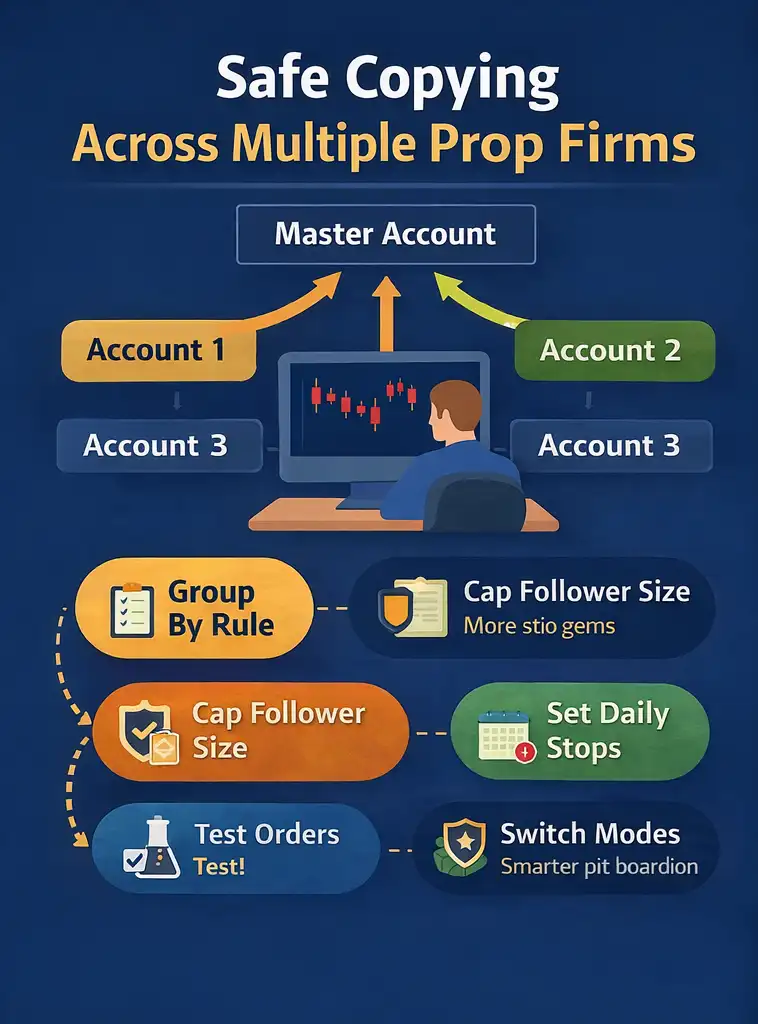
First: what “safe copying” actually means
Safe copying doesn’t mean “nothing can go wrong.” It means your workflow is built so that when something goes wrong (a bad fill, a missed stop, a loss streak), you don’t violate rules across multiple accounts at once.
Think of it like driving in rain. You don’t stop driving. You drive slower, leave more space, and avoid sharp moves.
If you haven’t set up your copier yet, start here:
Why copying across multiple firms is different than copying multiple accounts
Copying five accounts inside the same prop firm is already risky. Copying across different firms is a different game because the “environment” changes:
- Different drawdown types (EOD vs trailing)
- Different scaling rules (max contracts, phases)
- Different daily loss rules (some strict, some none)
- Different payout buffers and minimum-day requirements
- Different platforms/feeds and fill behavior
This is why I always tell people: don’t copy the strategy first — copy the risk plan first.
If drawdown mechanics still feel confusing, read this first (it’s the foundation):
The #1 rule: your master account is not the “truth” — your smallest account is
Most traders choose the biggest account as the master and copy 1:1. That’s usually backwards.
Safe copying principle: size everything based on the most fragile account in your group (smallest drawdown / strictest rules).
If your smallest account can only tolerate 1 contract safely, then your copier workflow should be designed around that — even if your biggest account could handle more.
This sounds “slow”… until you realize slow is what keeps you alive long enough to get paid.
Step 1: group your accounts by “rule profile” (not by brand)
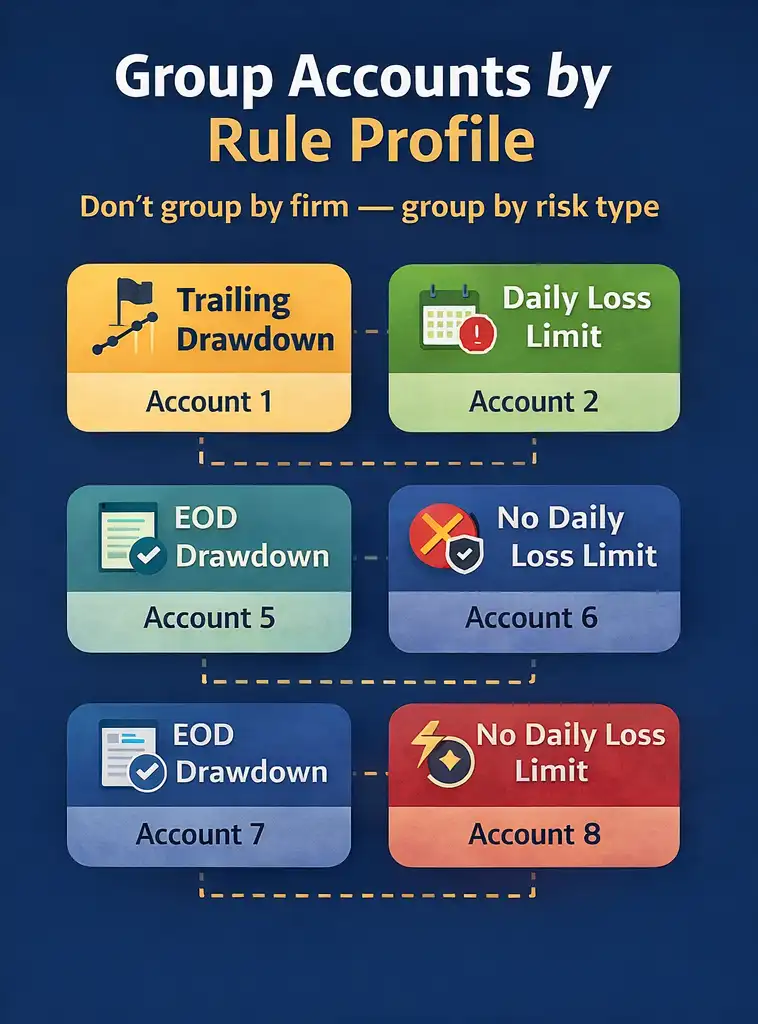
Before you copy anything, categorize your accounts into simple buckets:
- Trailing drawdown accounts (more fragile near equity highs)
- EOD drawdown accounts (more forgiving intraday, but still strict overall)
- Daily loss limit accounts (behavior control required)
- No daily loss accounts (danger: overtrading temptation)
This matters because you should not copy the same risk behavior into all of them. If you’re not clear on how drawdowns and payout rules actually work, read Futures Prop Firm Rules Explained (Drawdowns & Payouts) first.
If you’re not sure why traders still fail even with a profitable strategy, this explains it: Why Traders Fail Prop Firm Evaluations (Even When Profitable)
Step 2: set follower sizing like a risk manager (simple formulas)
Here are three safe ways to size followers. Pick one and keep it consistent.
Option A: Fixed max contracts per follower (most safe)
You manually cap each follower account to a max number of contracts, regardless of the master.
- Master: trades normally
- Follower A: max 1 contract
- Follower B: max 1 contract
- Follower C: max 2 contracts
Option B: Ratio-based sizing (safe if your accounts are similar)
Use ratios such as:
- Master 1.0x
- Followers 0.5x or 0.25x
Option C: “Smallest account rules everything” (simple and effective)
Every account receives the same small size (example: 1 contract), even if it feels underpowered.
If you only implement one thing from this article, implement sizing caps.
Step 3: build a personal daily stop rule (before the firm stops you)
Here’s the truth: relying on prop firm limits is how traders blow accounts.
Your daily stop should trigger before you approach any firm rule. A simple version:
- Stop trading after: 2 losing trades, or
- Stop trading after: -X dollars, or
- Stop trading after: you break your plan twice
This is the “seatbelt.” It doesn’t prevent every crash, but it prevents the deadly ones.
If you want the full breakdown of mistakes that cause failures, read:
Step 4: copy bracket orders correctly (or don’t copy at all)
This is where trade copiers can get traders into trouble:
- Stop loss doesn’t copy
- Take profit copies but stop doesn’t (danger)
- Follower order rejects due to max size
- Partial fills create different exposure across accounts
Safe rule: If your copier cannot reliably copy your stop loss, don’t copy live until you fix it.
Before you go live, test the full bracket copying process in sim for at least one session.
Step 5: treat “evaluation mode” and “payout mode” as different systems
Most traders copy aggressively during evaluations to pass quickly. Then they keep doing the same thing when they’re close to payout and end up violating a rule right before withdrawal.
Here’s the safer mindset:
- Evaluation mode: prove consistency and avoid drawdown spikes
- Payout mode: protect buffer, reduce size, trade less
If you want a clean framework for passing without gambling, use:
Common “safe copying” setups (examples)
Setup 1: One master + small identical followers
- Master: 1 contract
- Followers: 1 contract each
- Goal: consistent base hits
Setup 2: One master + conservative ratios
- Master: 2 contracts
- Followers: 0.5x (1 contract)
- Goal: master has flexibility, followers stay protected
Setup 3: Two groups (don’t mix rule profiles)
- Group A: trailing drawdown accounts (small size only)
- Group B: EOD drawdown accounts (slightly larger allowed)
- Goal: prevent one rule profile from dragging down the other
FAQ
Will copying across multiple firms get me in trouble?
Using a trade copier isn’t automatically a violation. The risk comes from rule breaches (drawdown, sizing, daily loss) and from inconsistent execution across accounts. Follow written firm rules and keep your risk plan conservative.
Why do my follower accounts show different fills?
Small differences can happen due to timing, routing, liquidity, platform, and partial fills. That’s why conservative sizing and proper bracket handling matter.
Should I copy during evaluations?
Only if your process is already stable. If you’re still overtrading or adjusting emotionally, copying will multiply those behaviors across accounts.
Related guides (to build the full system)
- Tradecopia Trade Copier Setup Guide
- Can Trade Copiers Break Futures Prop Firm Rules?
- Futures Prop Firm Rules Explained (Drawdowns & Payouts)
- Why Traders Fail Prop Firm Evaluations (Even When Profitable)
- How to Pass a Futures Prop Firm Evaluation (Without Gambling)
- Futures Trading Guides (Hub)
Bottom line
Trade copiers are powerful — and that’s the problem. They don’t break prop firm rules on their own, but they can amplify the behaviors that lead to rule violations: oversizing, overtrading, ignoring drawdown math, and reacting emotionally.
If you want to copy safely across multiple prop firms, keep it simple:
- Group accounts by rule profile
- Cap follower size conservatively
- Use a personal daily stop rule
- Verify bracket order copying
- Switch to “payout mode” near buffer targets
Do that, and a copier becomes what it should be: an execution tool — not a rule multiplier.
Disclaimer: This article is for educational purposes only and is not financial advice. Futures trading involves risk.