Can Trade Copiers Break Futures Prop Firm Rules?
Short answer: A trade copier doesn’t “break rules” by itself. Your execution does. A copier simply repeats your orders across accounts — which means it can multiply rule violations if your workflow isn’t controlled. This matters because most rule violations happen unintentionally — not from cheating, but from scaling mistakes.
In this guide, I’ll explain exactly how trade copiers interact with common futures prop firm rules (drawdowns, sizing, scaling, consistency, and payout conditions), what usually goes wrong, and how to set up a “safe copying” workflow.
What a trade copier is (in one sentence)
A trade copier connects a Master account (where you place trades) to one or more Follower accounts (that replicate the same entries/exits, usually with a ratio or sizing rule).
If you haven’t seen the setup process, start here: Tradecopia Trade Copier Setup Guide.
The real risk: a copier multiplies mistakes
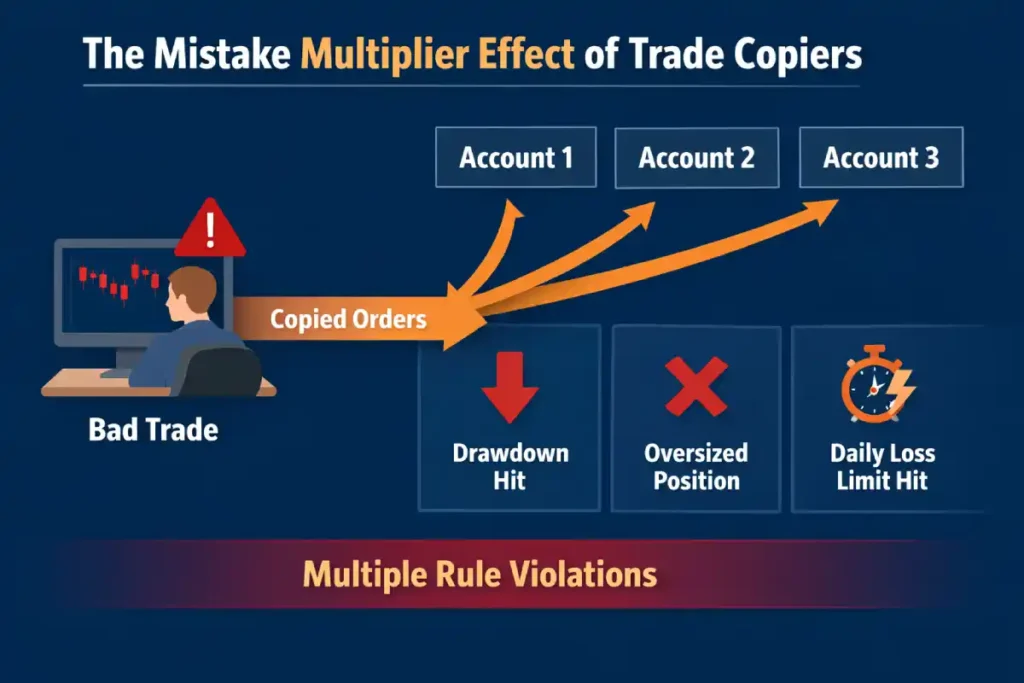
Think of it like this:
- One good trade → copied to 5 accounts → great.
- One bad decision → copied to 5 accounts → you can blow multiple accounts fast.
That’s why traders sometimes feel like a copier “caused” the failure. In reality, the copier just scaled the result.
Most traders don’t fail evaluations because of bad strategies, but because of execution and rule violations — I explain the root causes here: Why Most Traders Fail Prop Firm Evaluations (Even When Profitable).
Which prop firm rules can be affected by trade copiers?
Different firms have different wording, but most futures prop firm environments are built around these rule types:
- Drawdown rules (EOD drawdown or trailing drawdown)
- Daily loss rules (some firms have them, some don’t)
- Position size limits (max contracts, scaling limits)
- Consistency / concentration rules (sometimes)
- Payout eligibility rules (buffer, minimum days, etc.)
If you want a clear explanation of the rule mechanics (especially drawdowns), read:
Futures Prop Firm Rules Explained (Drawdowns & Payouts).
Rule-by-rule: how trade copiers can cause violations
1) Drawdown violations (EOD vs trailing drawdown)
This is the #1 risk area. A copier can cause drawdown violations when:
- You copy the same position size into smaller drawdown accounts.
- You keep trading after a loss and the copier repeats the behavior across accounts.
- Your trailing drawdown threshold rises, but your sizing stays aggressive.
Why it happens: Drawdown rules are often account-specific. A “normal” losing streak that is survivable in one account can be fatal in another.
What to do instead:
- Set follower sizing conservatively (ratios or max contracts).
- Use a personal daily stop rule that triggers before you approach drawdown limits.
- Reduce size after equity highs if trailing drawdown is in play.
These risks become even more important when traders copy across different firms with different rule profiles, which I break down step-by-step in Using Trade Copiers Across Multiple Prop Firms Safely.
2) Position size / scaling violations
Some traders blow evaluations because they copy trades without respecting each account’s max contracts or scaling phase.
Common copier mistake: You set a 1:1 copy and forget that Account B has stricter scaling rules than Account A.
What to do instead:
- Cap follower size independently (even if the master can trade larger).
- Use ratios (example: 0.5 size on smaller accounts).
- Review scaling rules before increasing size.
3) Daily loss limits (when they exist)
If a firm has a daily loss limit, a copier can trip it faster because it accelerates decision-making mistakes:
- Overtrading after a bad start
- Chasing price
- Adding size to “make it back”
What to do instead: Hard-stop your trading day with your own rule. Example:
- “If I’m down X or I break my plan twice, I stop.”
This behavior pattern is a major reason evaluations fail:
Top Mistakes Traders Make in Futures Prop Firm Challenges.
4) Consistency / concentration rules (if your firm uses them)
Some firms use rules that punish one big day or a highly concentrated profit distribution.
How a copier can make this worse: A copier makes it easier to “swing for the fences” across multiple accounts at the same time — which can create profit distribution that triggers consistency rules or triggers internal reviews.
What to do instead:
- Keep your per-trade risk consistent.
- Stop trying to “pass in one day.”
- Focus on repeatability, not speed.
5) Payout rules & buffers
Trade copiers don’t directly change payout rules, but they can influence whether you remain eligible by keeping your equity stable. Many traders reach payout eligibility and then violate rules right before withdrawing.
What to do instead: When you’re near buffer targets, treat your account like it’s fragile:
- Reduce size.
- Take fewer trades.
- Avoid “hero days.”
The safe copying workflow (simple and realistic)
If you want to use a copier without turning your accounts into a casino, use this workflow:
- Choose one master account (stable connection, consistent execution).
- Cap follower size (ratios or max contracts per follower).
- Bracket orders must copy correctly (SL/TP). Test in sim first.
- Create a personal daily stop rule that triggers before firm limits.
- Disable copying outside your trading window (avoid revenge sessions).
- Journal every copied session (so you remove repeated mistakes).
If you want a detailed setup walkthrough, use: Tradecopia Trade Copier Setup Guide.
Want the safest way to copy across accounts? Use my Trade Copier Risk Management Checklist (Futures Prop Firms) before you copy live. It’s a step-by-step rule-proof workflow built for prop firm drawdowns, sizing limits, and payout safety.
Common questions (FAQ)
Are trade copiers allowed by futures prop firms?
Many traders use them, but rules vary by firm. The safest approach is always to follow written terms and keep risk controlled. Even if allowed, the real issue is whether your workflow causes rule violations.
Can a copier cause slippage or execution differences between accounts?
Yes. Different accounts can fill slightly differently depending on liquidity, routing, platform, or timing. That’s another reason to keep follower sizing conservative and avoid over-leverage.
Should I use a copier during an evaluation?
Only if your process is already stable. Otherwise, you can multiply mistakes and blow multiple evaluations quickly. Start with:
How to Pass a Futures Prop Firm Evaluation (Without Gambling).
Related guides on futures prop firm trading
- Futures Prop Firm Rules Explained (Drawdowns & Payouts)
- How to Pass a Futures Prop Firm Evaluation (Without Gambling)
- Why Most Traders Fail Prop Firm Evaluations (Even When Profitable)
- Top Mistakes Traders Make in Futures Prop Firm Challenges
- Futures Trading Guides (Hub)
Bottom line
A trade copier won’t “break prop firm rules” on its own. But it can amplify the exact behaviors that fail evaluations: overtrading, oversizing, ignoring drawdown math, and trading emotionally. If you set conservative follower sizing, use a personal daily stop, and treat the rules as the environment (not the enemy), a copier can be a useful execution tool — not a risk multiplier.
Disclaimer: This article is for educational purposes only and is not financial advice. Trading futures involves risk.