
Why Most Traders Fail Prop Firm Evaluations (Even When Profitable)
Updated for 2026. If you’ve ever thought, “My strategy works… so why do I keep failing evaluations?” — you’re not alone. Prop firm evaluations don’t reward “being right.” They reward surviving the rules long enough to prove you can trade within a risk box.
I’ve watched this pattern repeat across firms and account sizes: traders can be profitable on a normal account, but fail evaluations because the evaluation is a constraint game, not a prediction game.
In this guide, I’m going to break down the real reasons traders fail — with plain language, practical examples, and what to do instead.
The core misunderstanding: evaluations aren’t about profitability
Most traders assume an evaluation measures:
- accuracy
- edge
- strategy quality
In reality, evaluations mostly measure:
- risk behavior under pressure
- drawdown management
- consistency of execution
- rule compliance over time
That’s why a trader can be “profitable” in their own tracking, but still blow the account with one emotional day.
If you haven’t read it yet, start here because it explains the rule mechanics that drive everything else:
Futures Prop Firm Rules Explained (Drawdowns & Payouts).
The 7 reasons profitable traders still fail evaluations
1) They trade their strategy, not the evaluation constraints
Evaluation rules create a specific environment:
- drawdown structure (EOD or trailing)
- position limits / scaling
- sometimes consistency rules
- sometimes time or minimum days
If your strategy needs large swings or wide stops, you might be profitable long-term — but the evaluation may not allow the variance your edge requires. That’s not “unfair.” It just means your execution needs to be shaped for the rule set.
What to do instead: Before you place a trade, ask: “Does this trade fit the drawdown math?” If you can’t answer in one sentence, it’s a no.
Related: How to Pass a Futures Prop Firm Evaluation (Without Gambling)
2) They misunderstand drawdown (especially trailing drawdown)
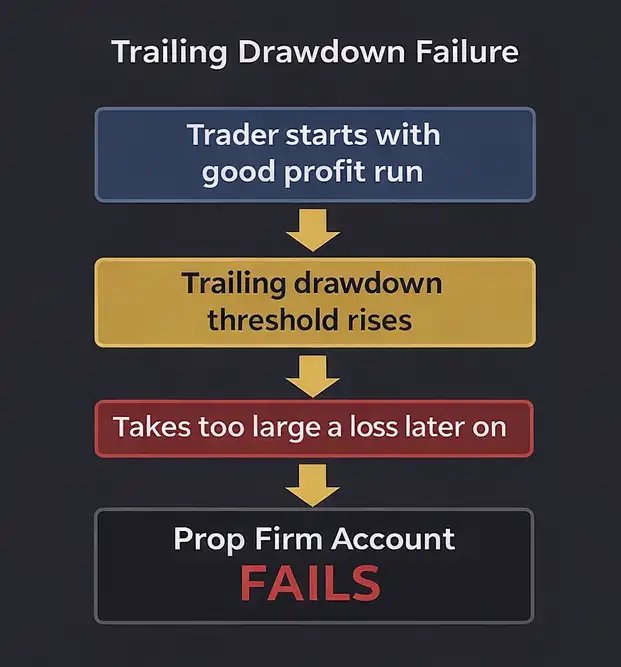
Trailing drawdown is where good traders die. Not because they’re bad — because they assume it behaves like a normal stop-out. It doesn’t.
Common failure pattern:
- Trader gets a good run early
- Trailing threshold rises
- One rough trade day pulls them under the moving threshold
- Account fails even though “overall” they were doing fine
If drawdown logic isn’t second nature, your evaluation becomes a mental tax every day.
What to do instead: Build a simple daily rule: “My worst-case day must not cross the drawdown line.” If you want the clean explanation of drawdown types, read:
Drawdowns explained here.
3) One revenge day wipes out two weeks of progress
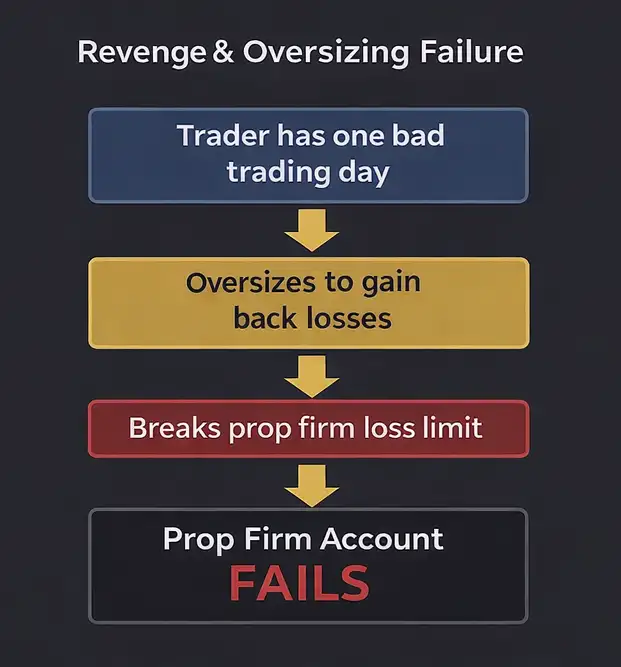
This is probably the most common reason “profitable” traders fail.
They trade well for 8–12 days, then one day:
- they miss an entry
- they take a lower-quality setup
- price snaps back
- they size up to “get it back”
In a normal account, maybe that day is survivable. In an evaluation, it often isn’t.
What to do instead: Define a “stop trading rule” that triggers before the firm’s limits do. Example:
“If I’m down X or I break my plan twice, I’m done for the day.”
If you want a checklist-style view of the behaviors that cause blow-ups, this complements the topic:
Top Mistakes Traders Make in Futures Prop Firm Challenges.
4) They overtrade because the evaluation feels like a race
Evaluations create a weird psychological pressure: “If I don’t pass fast, I’m wasting time.” That pressure leads to:
- taking marginal setups
- forcing trades in chop
- trading times you normally avoid
Even when your system works, your selection quality drops — and the evaluation punishes selection errors hard.
What to do instead: Reframe the goal: “My job is not to pass quickly. My job is to stay alive and execute well. Passing is a side effect.”
5) They use position size that’s mathematically incompatible with the rules
This is the silent killer. Many traders fail because they never did the basic math:
- What is the max drawdown?
- What is my typical stop size?
- How many stop-outs can I take before failure?
If the answer is “two losses and I’m close to failing,” your system might still be profitable — but it’s too fragile for the evaluation environment.
What to do instead: Set size so you can take a reasonable number of losses without approaching the failure line. That gives your edge room to work.
6) They trade inconsistent products and sessions
Some traders mix:
- ES + NQ + CL depending on mood
- London session one day, NY open the next
- random news trading
They might still be “profitable” over a month — but evaluations expose inconsistency because the risk profile changes daily.
What to do instead: Choose one core instrument and one core session for the evaluation period. Your job is to reduce variance, not increase opportunity.
7) They don’t build a repeatable execution workflow
Prop firm success is often boring:
- same checklist
- same risk cap
- same entry criteria
- same stop behavior
The “profitable but failing” trader usually has edge — but no stable workflow under stress.
What to do instead: Use a simple journaling process and repeatable rules. If you haven’t set up a journal yet, start with:
Futures Trading Journal Template.
A quick self-check (be honest)
If you answer “yes” to 2+ of these, you’ve found your failure point:
- Do I ever size up after a loss?
- Do I trade more when I’m down?
- Do I keep trading after breaking my plan once?
- Do I ignore drawdown math and “hope it works out”?
- Do I treat the evaluation like a race?
This is not about being perfect. It’s about removing the one or two behaviors that consistently blow accounts.
What to do next: a simple passing framework
Here’s a framework that works across firms because it’s rule-first:
- Define your maximum daily damage (your rule, not the firm’s).
- Trade only your A+ setup during evaluation periods.
- Keep position sizing boring and consistent.
- Stop trading when emotions show up (revenge, frustration, urgency).
- Journal each session so you can remove repeated mistakes.
If you want the step-by-step “how to pass” process in one place, this is the companion guide:
How to Pass a Futures Prop Firm Evaluation (Without Gambling).
Quick FAQ
Is it possible to be profitable and still fail evaluations?
Yes. Profitability over time doesn’t protect you from rule-based failure events. Evaluations punish volatility, inconsistency, and emotional sizing much faster than a normal account would.
What’s the fastest way to stop failing?
Identify your “one blow-up behavior” (revenge sizing, overtrading, ignoring drawdown math) and build a hard stop-rule around it. Most traders don’t need a new strategy — they need guardrails.
Should I focus on one prop firm during evaluation?
Usually yes. Running multiple evaluations at once can multiply emotional pressure. If you do trade multiple accounts, use strict size controls and a workflow that prevents accidental oversizing.
Internal links: next reads on It’s Trading Star
- How to Pass a Futures Prop Firm Evaluation (Without Gambling)
- Futures Prop Firm Rules Explained (Drawdowns & Payouts)
- Top Mistakes Traders Make in Futures Prop Firm Challenges
- Futures Prop Firm Reviews (Hub)
- Futures Trading Guides (Hub)
Final note
If you’re failing evaluations while staying profitable overall, it doesn’t mean you’re “bad.” It usually means your trading behavior is incompatible with a rule-based environment. Fix the one or two repeat mistakes, shape your execution to the constraints, and the evaluation becomes manageable.
Disclaimer: This content is for educational purposes only and does not constitute financial advice. Trading futures involves significant risk.