
Futures Prop Firm Rules Explained (Drawdowns, Scaling, Payouts)
drawdown, daily loss limits, scaling,
consistency, and payout eligibility.
Once you understand these entities, every prop firm starts to feel predictable.This guide explains the rules in plain language, shows how they work in real trading, and helps you avoid the mistakes
that blow accounts (especially after you’re in profit).
The 5 Core Rule Entities
Most futures prop firm rulebooks are just different versions of the same structure. If you learn these five entities,
you’ll understand 90% of what matters:
- Profit Target: the required profit to pass an evaluation or qualify for funding.
- Drawdown / Max Loss: the maximum loss your account can take before it fails.
- Daily Loss Limit (DLL): a daily stop rule that limits how bad one day can get.
- Scaling: position-size restrictions that control how many contracts you can trade.
- Payout Eligibility: rules that determine when and how much you can withdraw.
Drawdowns Explained (EOD vs Trailing vs DLL)
Drawdown is the most important rule in any futures prop firm account because it controls your survival time. Even profitable traders fail prop firm accounts because they don’t respect how drawdown behaves.
If you’re confused about how trailing drawdown compares to end-of-day limits, read this detailed breakdown: End of Day vs Trailing Drawdown (Futures Prop Firms Explained).
1) End-of-Day (EOD) Drawdown
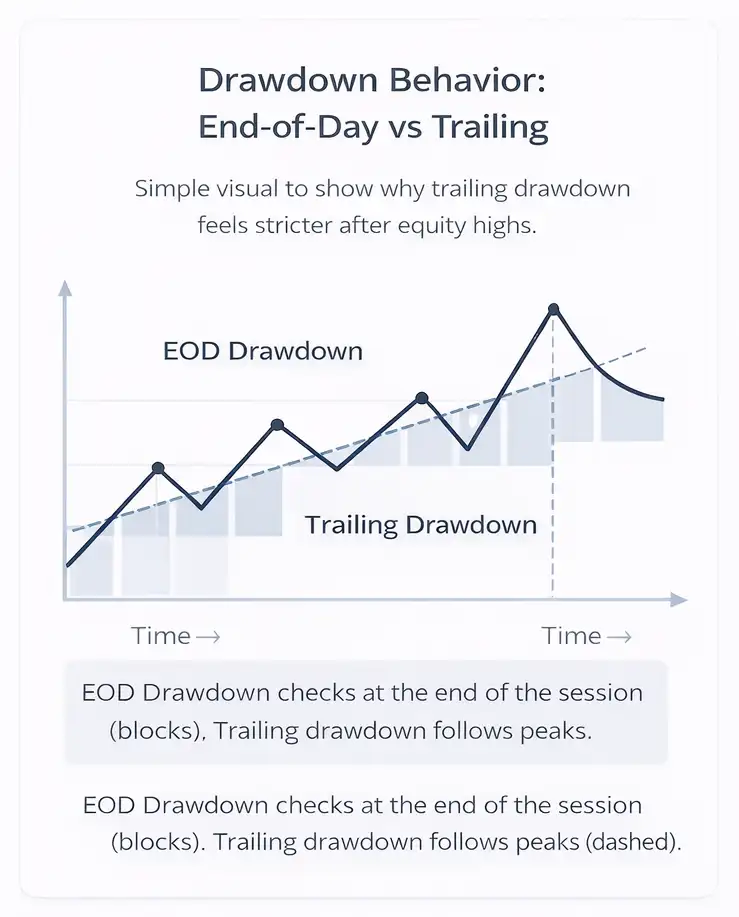
With EOD drawdown, the firm checks your account at a specific daily time (end of session). This is often more forgiving for day traders because intraday swings don’t automatically fail you—your end-of-day balance matters most.
2) Trailing Drawdown
Trailing drawdown follows your peak equity. If you make money and then give it back, the trailing line can “catch up” and stop you out. This model punishes giving back profits after a green run.
3) Daily Loss Limit (DLL)
DLL is a daily stop rule. Depending on the firm and account type, hitting DLL can either:
(a) stop your trading for the day, or (b) fail the account if you keep trading through it.
The key is to treat DLL as your “hard stop,” not a challenge.
Practical takeaway: Your strategy doesn’t fail prop firms. Your risk behavior fails prop firms.
Drawdown is the rule that exposes bad risk behavior.
Visual: How EOD vs Trailing Drawdown Behaves
Scaling Rules (Why You Can’t “Size Up” Too Fast)
Scaling rules exist because prop firms want you to behave like a professional risk manager, not a gambler. Even if you’re profitable, they don’t want you jumping from 1 contract to 10 contracts overnight.
What scaling usually controls
- Maximum contracts allowed (minis/micros).
- When you can increase size (based on equity, buffer, or milestones).
- How quickly risk can expand without blowing the account.
Key takeaway:
Scaling is a “behavior constraint” entity. It’s not there to annoy you. It’s there to measure whether your edge holds up under controlled risk growth.
Simple rule that keeps you funded:
Increase size only after you have a buffer AND a stable equity curve.
If you size up while emotionally excited, you’re usually one red candle away from breaking rules.
Payout Rules (Buffers, Profitable Days, Caps)
Payout rules are often misunderstood. Most firms won’t let you withdraw the moment you’re $50 in profit. They use payout rules to filter out “one good day” performance.
Common payout entities
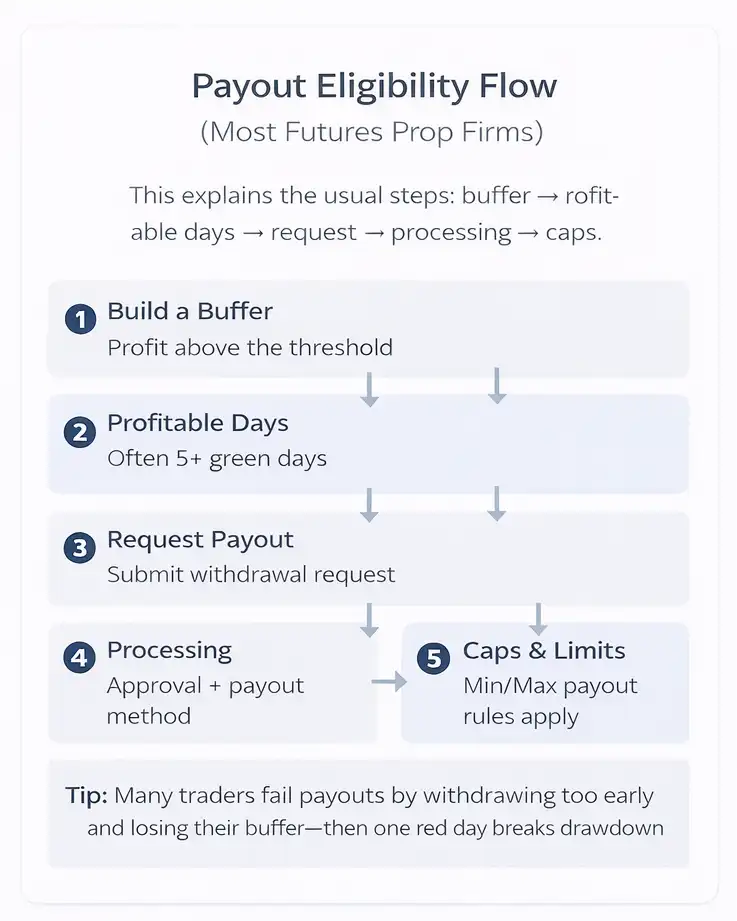
- Buffer: extra profit above a threshold before withdrawals are allowed.
- Profitable days: minimum number of green days required.
- Minimum payout: you must withdraw at least a set amount.
- Payout caps: maximum withdrawal per request or per period.
- Consistency: prevents withdrawing after one oversized day.
A firm might allow daily payouts, but only after you build a buffer. Another might allow payouts weekly but with fewer restrictions. The rulebook tells you what type of trader they’re trying to fund.
Visual: Payout Eligibility Flow
How to Read Any Prop Firm Rulebook in 5 Minutes
- Find the drawdown model (EOD vs trailing). This tells you how strict the account feels.
- Check DLL (if it exists). Decide your own daily stop before you hit theirs.
- Check contract limits. This controls how quickly you can progress.
- Check payouts (buffer, profitable days, caps). This tells you how the firm rewards performance.
- Check forbidden behavior (HFT, hedging, copy-trading restrictions). Avoid accidental violations.
Top Rule Mistakes That Blow Accounts
- Ignoring trailing drawdown after a big green day.
- Trading after DLL because you want to “save” the day.
- Oversizing to hit target quickly instead of progressing steadily.
- Breaking consistency rules with one jackpot day.
- Withdrawing too early and removing your buffer (then one loss knocks you out).
Most failures are not “bad strategy.” They’re violations of the risk model.
FAQ
What drawdown model is easiest to manage?
For many day traders, End-of-Day (EOD) drawdown feels easier because intraday volatility doesn’t auto-fail the account.
Trailing drawdown can be stricter because it punishes giving back profits from equity highs.
Why do prop firms use consistency rules?
Consistency rules exist to prevent “one lucky day” performance. They want repeatability, not randomness.
Can I withdraw daily from a futures prop firm?
Some firms allow frequent withdrawals, but payout eligibility usually depends on buffers, profitable days, and minimum payout thresholds.
Related Reviews & Guides
Use these pages to connect this guide into your topical cluster: