
Lucid Trading Review (2026 Updated)
Last updated: January 2026
Lucid Trading is one of the few futures prop firms where the rules actually make sense: no monthly rebilling on evaluations, clear drawdown logic, and fast payouts. I’ve passed multiple 50K evaluations here, blown more than a few funded accounts, and I’m currently working on a 50K LucidFlex eval. This review sums up how LucidPro, LucidFlex, and LucidDirect really work – plus what I learned the hard way.
Lucid Trading Overview – LucidPro, LucidFlex, LucidDirect
Lucid runs three main simulated paths into live capital LucidPro (classic evaluation → funded), LucidFlex (more flexible eval & payout design), and LucidDirect (straight-to-funded, no eval). All evaluations are one-time fees, not subscriptions, and you upgrade within minutes when you hit the target.
| Program | Phase | Key Idea |
|---|---|---|
| LucidPro | Evaluation → Pro funded sim → LucidLive | Classic one-phase evaluation with profit target, EOD max loss limit and daily loss limit on most sizes. One-time fee, no monthly rebilling, pass in one day if you hit the target cleanly. |
| LucidFlex | Flex eval → Flex funded sim → LucidLive | More flexible evaluation with no daily loss limit on the eval, 50% consistency requirement and EOD max loss. Also a one-time fee with no time limit to pass. |
| LucidDirect | Straight-to-funded sim → LucidLive | Skip the evaluation completely. Buy a direct-funded account (50K or 150K), trade under fixed and scaling DLL rules, and request payouts as soon as you qualify. |
Note: Exact profit targets, max loss limits, consistency percentages and contract limits differ by account size. Always double-check Lucid’s official Help Center for the latest tables.
LucidPro – One-Time Evaluation With DLL
LucidPro is the “classic” evaluation path. You start in a simulated evaluation account and move to a funded sim once you hit the profit target and respect the rules.
LucidPro Evaluation – Core Rules
- Account sizes: 25K, 50K, 100K, 150K.
- Profit targets scale with size (e.g. 50K → $3,000; 100K → $6,000).
- End-of-Day Max Loss Limit (EOD trailing drawdown) per size
– if your closed balance finishes below MLL, eval ends. - Daily Loss Limit on 50K+ – once hit, you’re done for the day but not auto-failed
unless you also cross the MLL. - Max size: up to 10 minis or 100 micros on the largest eval.
- One-time fee, no monthly rebilling, no minimum trading days – you can pass in 1 day.
- Upgrade to funded sim typically within 5–30 minutes after hitting target.
Once you pass, you’re moved to a LucidPro funded sim with payouts, consistency rules and a path toward LucidLive (real brokerage capital).
LucidFlex – My Current Path (50K Evaluation)
LucidFlex is the newer, more flexible track I’m personally using right now – I’m currently on a 50K LucidFlex evaluation. The eval still has a profit target and max loss, but there is no daily loss limit on the eval itself.
LucidFlex Evaluation – Core Rules
- Account sizes: 25K, 50K, 100K, 150K.
- Profit targets: roughly 5–6% (e.g. 50K → $3,000; 100K → $6,000; 150K → $9,000).
- End-of-Day Max Loss Limit per size (e.g. 50K → $2,000; 100K → $3,000).
- No DLL on the LucidFlex evaluation.
- 50% consistency requirement on the eval – built with some cushion so you can pass in as few
as two days if you trade cleanly. - Max size scales from 2 minis / 20 micros (25K) up to 10 minis / 100 micros (150K).
- One-time fee, no monthly rebilling, no time limit – you can take as long as you need.
- Instant upgrade to Flex funded sim once you hit target and satisfy consistency.
LucidFlex Funded – Payout Logic
- Profit split: 90% to you, 10% to Lucid on Flex funded accounts.
- Payout eligibility: at least 5 profitable days in a payout cycle,
each with a minimum daily profit depending on account size
(e.g. 50K → min $150/day on 5 separate days). - You only need positive net profit for the cycle to request a payout.
- Minimum payout: typically around $500 per request.
- Maximum payout: up to 50% of the account balance with hard caps per size
(e.g. 50K Flex → up to about $2,000 per request). - Up to 6 payouts on each LucidFlex account before you’re moved to LucidLive.
- No fixed “payout window” – once you meet the rules, you can request on any day.
- Payouts are usually processed fast (minutes to deduct from account, typically within ~2 business
days to reach your method).
LucidDirect – Skip Evaluation, Trade for Payouts Day One
LucidDirect is the straight-to-funded option. You pay once for the account (no activation fee, no monthly billing) and start trading a funded simulated account immediately.
LucidDirect Funded – Core Rules
- Account sizes: 25K, 50K, 150K.
- Max Loss Limit (EOD trailing) per size (e.g. 50K → $2,000; 150K → $6,000).
- Fixed Daily Loss Limit on 50K+ (e.g. 50K → $1,200 per day, 150K → $3,600).
- Scaling DLL that grows with your peak end-of-day balance (percentage of peak EOD, on larger sizes),
giving more breathing room as you earn. - No scaling plan on contracts – you can use the full max size from day one.
- No simulated payout caps; payouts follow the standard Lucid payout structure and conditions.
LucidDirect is built for traders who are confident in their edge and want to trade for payouts without any evaluation phase. The trade-off is a stricter DLL plus the need for strong consistency.
My Real Experience With Lucid Trading
I don’t just read rule pages – I’ve put real screen-time into Lucid:
- I’ve passed five 50K test/evaluation accounts at Lucid. The rule clarity
and one-time fee model helped me stay focused on trading instead of billing. - I’ve also blown five 50K LucidPro funded accounts. Every single one came
down to the same thing: pushing too hard after a good run and giving back too much into the
EOD max loss or daily loss limit. - Right now I’m working on a 50K LucidFlex evaluation, using smaller size and
a stricter journal to respect the 50% consistency and max loss.
These are the kinds of experiences that never show on a simple “rule summary”, but they’re exactly what matters: how the risk model feels when you’re actually trading it.
Proof: My Lucid Dashboards (Passed, Blown & Current)
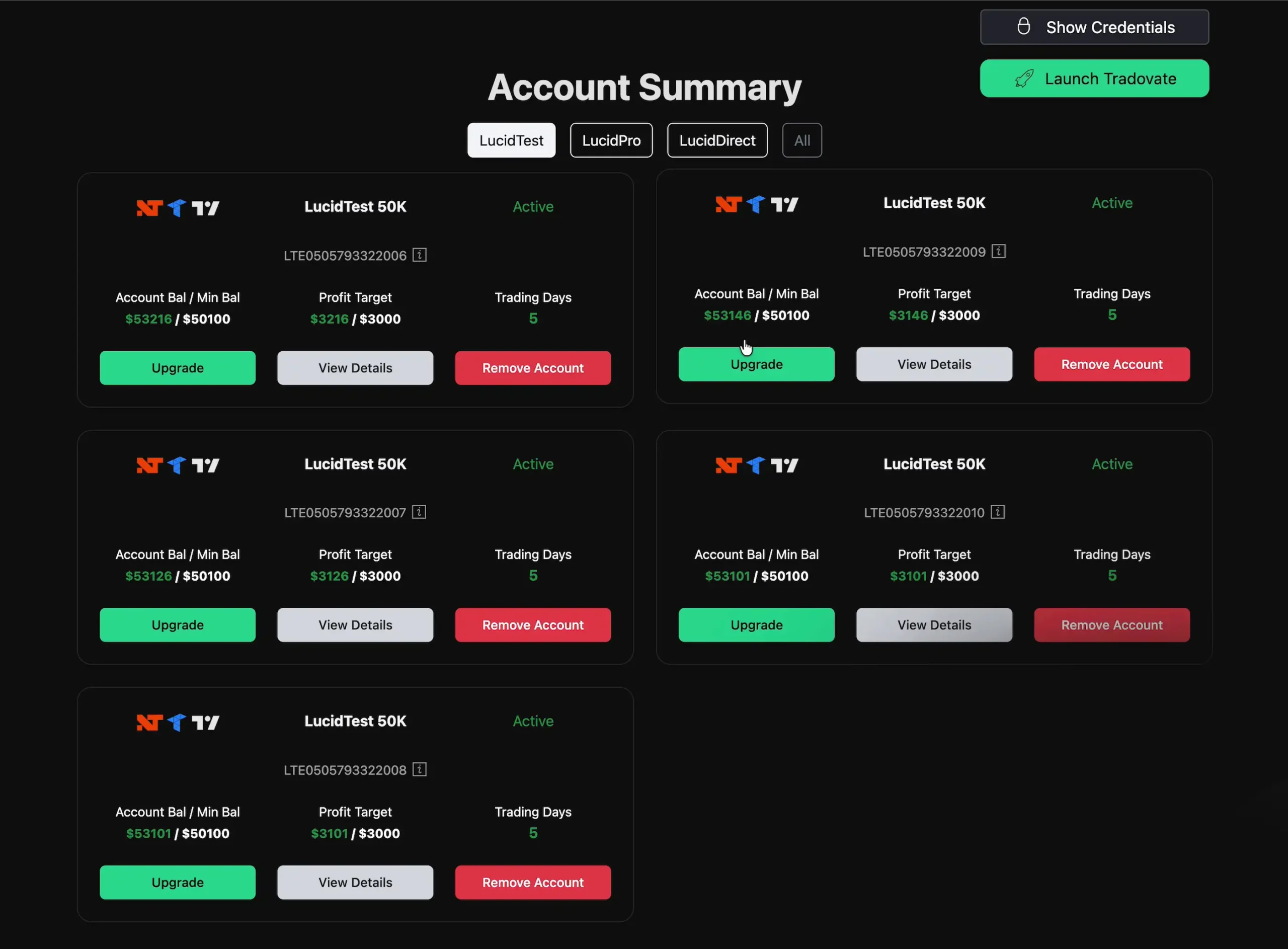
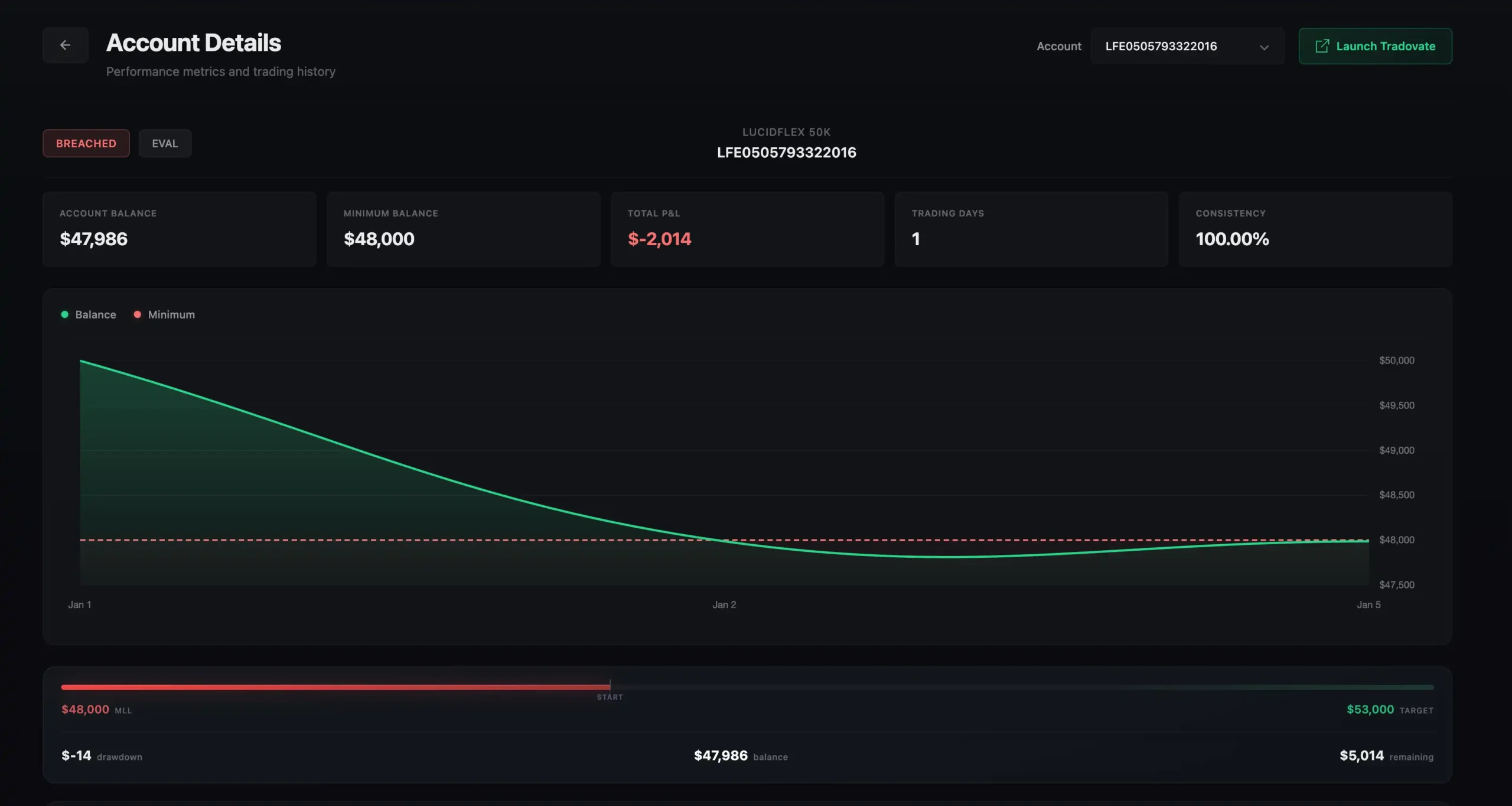
Blown eval account: 50K Flex eval where I pushed too hard by overleveraging to pass in 2 days
Lucid Trading Pros & Cons (From My Perspective)
Pros
- One-time evaluation fees, no monthly rebilling.
- Clear rule documentation and transparent knowledge base.
- Multiple paths: Pro, Flex, Direct – you can pick what fits your personality.
- End-of-Day max loss logic that’s easy to understand and plan around.
- Fast, frequent payouts once you qualify; no fixed payout windows.
- Real path to LucidLive (live brokerage capital) after consistent performance.
Cons / Risks
- Daily loss limits and consistency rules will punish impulsive, “all-in” behaviour.
- Easy to over-trade multiple 50K accounts and blow several in a row if you’re not
strict with risk (I’ve done it). - Direct funding (LucidDirect) is expensive if you’re still learning and likely
to treat it like a lottery ticket. - Like any prop firm, rules can change – you must stay on top of updates.
Should You Try Lucid Trading?
If you’re a futures trader who wants a no-nonsense, one-time-fee prop firm, Lucid is worth testing. Just remember: your risk plan matters more than the discount code.
Affiliate disclosure: If you sign up through my link, I may earn a commission at no extra cost to you. I only recommend firms I’ve personally traded with.
More Prop Firm Reviews & Resources
To understand where Lucid fits in the futures prop-firm landscape, here are other pages on this site that connect to the same topic:
- Take Profit Trader Review (2026 Updated) –
another futures prop firm with no daily loss limit and daily payouts. - Topstep Review (2026 Updated) –
how a more “old-school” firm compares to newer players like Lucid. - Free Futures Trading Resources –
my journal template, prop firm rule cheat-sheets and risk calculators. - About It’s Trading Star –
my trading background, how I use prop firms, and what I’m currently working on.